


THE SPIRAL: Inside Moonrock’s AI Filmmaking System
Human creative direction, autonomous execution and control at every stage.
AI can generate a convincing shot. A film asks more: camera positions, performances and object states need to work together across the edit. When those relationships are discovered only after generation, each unresolved directing decision can become another round of paid experiments.
THE SPIRAL is a short film in development at Moonrock, created using our in-house production system, which we call the Untitled AI Filmmaking System. Here, we present the film’s opening sequence and the system behind it.
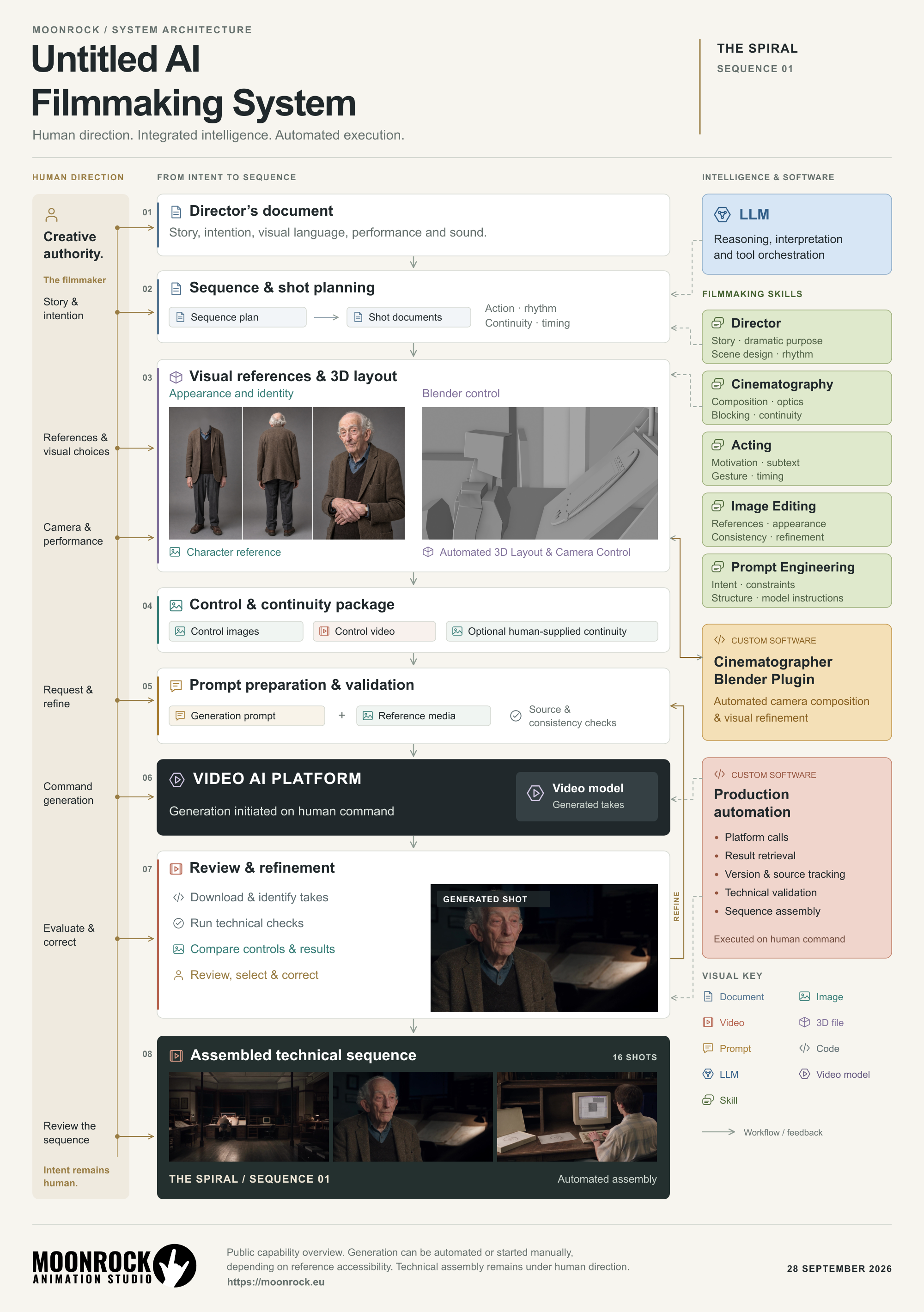
We built this system to carry creative decisions through production. It starts with a director’s document, written by the filmmaker with AI assistance if they choose. From that foundation, the system can work autonomously at every subsequent stage, within the project’s permissions. The filmmaker can take over at any point, edit the working material directly and hand it back; the system interprets the updated state and continues from it.
Here is the system behind THE SPIRAL, its first public case study.
Watch the opening sequence
The cut below was assembled automatically by the system from the selected footage. The only manual editing afterward consisted of adding fades to mark changes in time of day. The preview retains the audio generated with the footage, including sound effects and occasional musical fragments. Sound post-production and music production are currently outside the system’s scope.
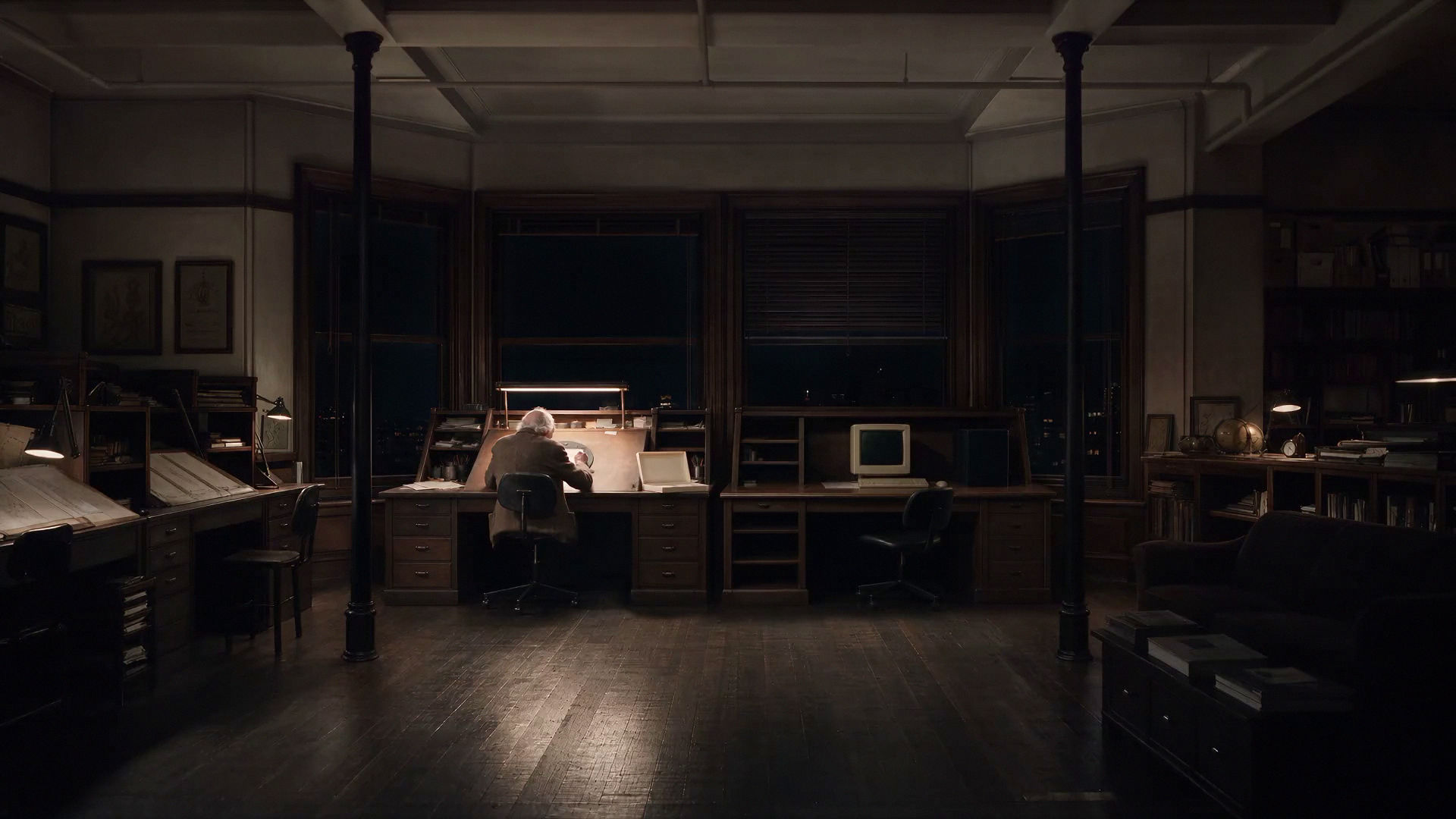
THE SPIRAL follows a recurring image across three generations of image-making: hand-drawn animation in the early 1990s, 3D from the 1990s to the 2020s, and generative AI in the late 2020s. In the opening sequence, an older animator’s work passes to a younger artist through drawings left in a shared studio.
The geography of the room, the handling of a drawing and the timing of a look carry meaning across the edit. A change in an object’s position or what a character appears to notice can change the story. That made the sequence a useful test of whether a production system could preserve directing decisions across shots with a realistic amount of work.
From creative direction to editable 3D scenes
The director’s document establishes the story, dramatic intention, visual language, performance and sound. From it, the system creates the sequence plan and detailed shot descriptions, developing action, performance instructions, staging and camera requirements for each shot.
It then builds spatial layouts and camera setups in Blender through our production tools, including a custom Cinematographer Blender Plugin. From these scenes, it renders static spatial control images and prepares generation prompts with the required visual references. Each stage builds on the system’s earlier outputs and any refinements made by the filmmaker.
The filmmaker can open a system-generated Blender scene, move the camera or adjust the staging, and save the revised version. The system interprets that scene and uses it for subsequent controls and generation preparation. It can also continue refining the layout when asked.
This makes direct editing part of the collaboration. The working material stays accessible to the person responsible for the film. Changes made outside the connected workflow are brought back into the project before the system continues from them.
Make creative decisions before generating footage
Our early approach relied on individually designed start frames. Building the layouts in Blender gave us a shared spatial basis for planning the sequence. The system renders static control images from these layouts, with one or more images for a scene.
These images primarily guide generation, but they also let us preview the film through its key setups. Reviewing them in sequence lets us assess framing, staging, object placement and spatial continuity, and make creative changes before spending video-generation credits. Movement, performance and precise timing can then be evaluated in the generated footage.
Resolving these spatial and compositional decisions early can substantially reduce avoidable generation and regeneration costs, particularly in longer productions where one late creative change may affect many shots.
The comparison below places these static 3D control images alongside the generated footage, showing how the planned setups relate to the resulting moving images.
Watch the 3D control and generated footage comparison:
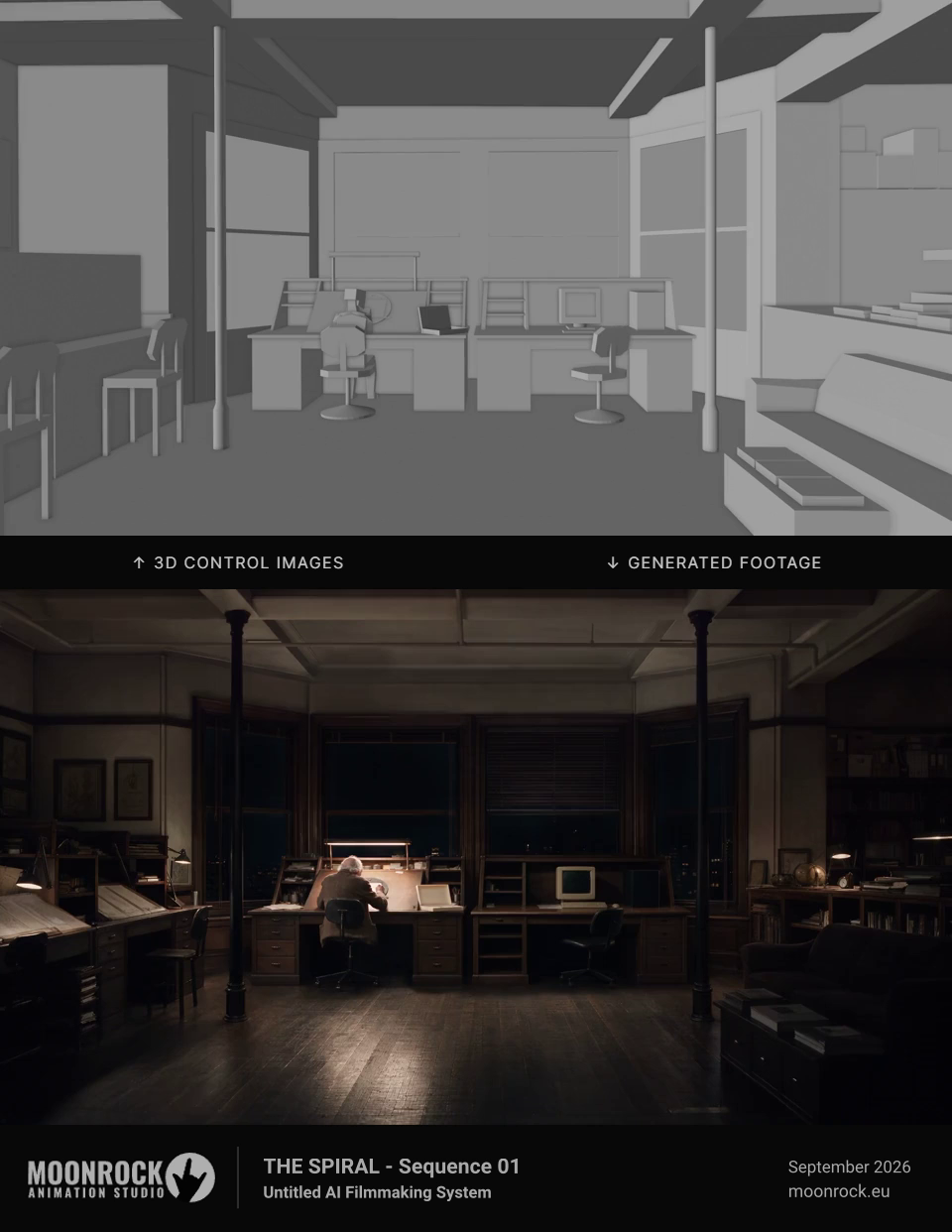
Controls guide selected camera, staging and geometry decisions; appearance comes from character, prop and location references.
Keep revisions connected to the film
The system carries a shared spatial plan, characters, object states and directing decisions through the sequence. Before a generation task is released, it checks that the required inputs are present and current. Production outputs retain their relationship to the sources and prompts behind them.
Clear responsibilities make corrections more specific. During development, temporary colours in the 3D controls could influence the generated appearance. We made neutral clay controls the default for new layouts, separating spatial guidance from the character, prop and location references that define the intended look. This gives the team a clearer way to distinguish a planning problem from an appearance problem.
When selected footage is available, the system can assemble a clean preview, a contact sheet and a moving control comparison. Reviewing the shots together reveals whether an action reads correctly, an object remains consistent or a performance supports the edit. The filmmaker can return to the relevant source and prepare a targeted revision.
This architecture draws on Gábor Marinov’s experience as a VFX supervisor and more than a decade developing Limes, a CG/VFX production management system. That work provided the software development and architectural foundation for connecting creative decisions, production states, revisions and handovers.
What this sequence demonstrates
With the opening sequence of THE SPIRAL, we set out to examine the cinematic quality achievable with a realistic amount of work in a system intended for making longer productions, including feature-length films.
For Sequence One, our chosen workflow includes manually starting video generation after reviewing the prepared task. Optional human-supplied continuity references and manual corrections also feed into the work. The assembled technical preview supports editorial decisions; final creative judgement remains with the filmmakers.
In our assessment, working from the relationships across the whole sequence produced a high level of consistency compared with sequences of independently prompted shots, and the sequence reached a quality suitable for professional production use.
There is always room for further refinement. Stopping at this version was a deliberate decision: we could already evaluate the relationship between the work invested and the quality achieved. The system allows filmmakers to return to the smallest details of individual shots and refine them further in line with the production’s quality goals and available resources.
Bring us a scene from your next film
We are interested in production collaborations with directors and producers, developing films from a partner’s idea, and tailored implementation or transfer of the system into other studios. A useful starting point is one scene: the intention behind it, the visual challenge, and what the production needs to achieve. From there, we can discuss an appropriate pilot and the scope of a collaboration.
Let’s discuss a scene from your next film.
Gabor Marinov — Director & AI Production System Architect
Bernadett Dian — Art Director & Generative Production Artist